An Intercom alternative for mobile games and apps
Intercom charges per seat and per AI resolution, and its mobile SDKs stop at iOS, Android and React Native. Here's what that means for a game or a small app, what a game-first tool does differently, and the cases where Intercom is still worth it.
Published 2 November 2026 by the Inngame team. We make Inngame, so read this as a comparison from one side; Intercom's prices are quoted from its own pages on that date.
Intercom is good software. If you run a SaaS with a sales team, a marketing team and a support team that all want to talk to the same customers, it does a lot of things well. The trouble starts when the product is a game or a small mobile app: you pay per seat for features you'll never open, and the parts a game needs (an SDK for your engine, gamepad navigation, the player's device and build attached to every message) aren't really what Intercom was built around.
What Intercom costs a small team
Intercom's pricing has two parts: seats, and usage. On its pricing page, checked on 2 November 2026:
| Intercom | Listed price |
|---|---|
| Essential | $29 per seat per month (shown at $19 for new customers) |
| Advanced | $85 to $99 per seat per month, depending on annual or monthly billing |
| Expert | $132 to $139 per seat per month, depending on billing |
| Fin AI Agent | From $0.99 per "Fin outcome", on top of seats |
| Copilot (AI help for agents) | $29 per agent per month billed annually, $35 monthly |
| Trial | 14 days, no card |
Three people answering on Essential is 3 × $29 = $87 a month before Fin answers anything. Every question Fin resolves adds roughly a dollar. For a SaaS with a $50 average plan that's fine. For a game that sells a $4.99 pack, a dollar per AI answer adds up quickly.
For comparison, Inngame's Indie plan is €29 a month flat with 3 seats, 2 apps, 1,000 AI messages and 20,000 translations included; Studio is €99 with 15 seats and 20 apps. Both have a 14-day trial, and you can plug in your own Anthropic or OpenAI key to remove the AI cap. An "AI message" and a "Fin outcome" aren't the same unit (one counts replies, the other counts resolutions), so treat this as an order of magnitude, not a like-for-like quote.
The SDK question: Unity, iOS, web
Intercom ships native SDKs for iOS and Android, plus an official React Native wrapper (released in June 2021, according to its mobile SDK FAQ). The same FAQ puts the SDKs at roughly 9 MB on iOS and 7 MB on Android, says Xamarin needs community libraries, and doesn't mention Unity or any game engine. Studios that want Intercom in a Unity game end up writing a native bridge per platform, and the desktop builds (Steam, Mac, Linux) get nothing.
Inngame went the other way round and started from the engine:
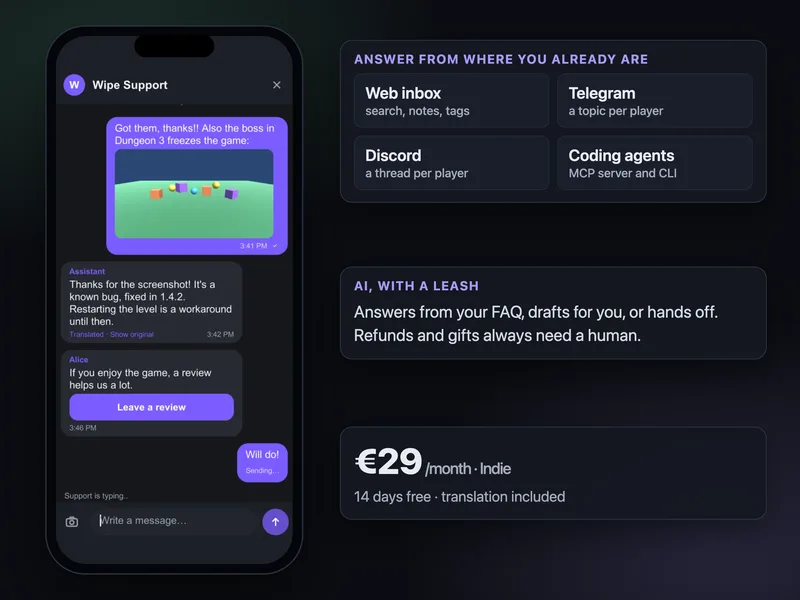
- Unity (2022.3 LTS and Unity 6): one package for iOS, Android, Windows, macOS and Linux, Steam included, with WebGL on polling. The chat UI is drawn by the SDK on its own canvas, with full gamepad navigation and the Steam Deck keyboard.
- iOS: a Swift package for regular apps, iOS 16 and later, SwiftUI or UIKit.
- Web: one script tag, 22 KB gzipped, for HTML5 games and web apps.
To be fair about the gap: there's no native Android SDK outside Unity, and no React Native or Flutter package. If your product is a native Android app or a React Native app, Intercom covers you today and Inngame doesn't.
What a game needs that a help desk doesn't
Most of the difference isn't the price. It's what arrives with the message.
- Context without asking. In Inngame's Unity SDK each message carries the scene and the last 10 scenes, build and SDK versions, device, OS, GPU, resolution, FPS, memory and the last 50 log lines with stack traces. A help desk widget sees a browser-like session and whatever custom attributes you push yourself.
- Screenshots from inside the game. F8 on desktop, or shake to report on a phone; the chat itself is never in the capture.
- Identity that follows the player. Anonymous until login, then a JWT signed by your server or a Steam ticket that Inngame verifies with Valve. The history follows them to a new device.
- Translation both ways, included. Players write in their language, your team reads and replies in theirs, and both sides can see the original. Intercom counts AI auto-translation as usage (its pricing page gives each agent 10 auto-translated conversations a month for free); in Inngame translation is part of every plan, with a monthly allowance.
- Cards that act in the game. A review request, a link, a screen of the game, an offer, a one-time claimable item, or Apple's refund sheet, sent from the conversation.
- Answering from where the team already is. A web inbox, or a Telegram topic or Discord thread per player. Small studios rarely sit in a help desk all day.
AI: answer, draft, or stay out
Fin is one of the strongest AI support agents around, and it's priced per outcome because it's meant to close tickets on its own. Inngame's AI is more conservative by design. It answers only from your FAQ and the conversation, writes in your team's language (translated for the player), and hands off when a player is angry, asks for money, reports a payment or account problem, or mentions anything legal or safety-related. You choose per game and per conversation whether it answers, drafts for a human to approve, or stays off; it's off until you turn it on. Refunds and gifts always need a signed-in human.
When Intercom is still the right choice
- You need email, chat, phone and a public help center in one place. Inngame has no email inbox and no public help center site; its FAQ lives inside the chat.
- Your app is native Android, React Native or Flutter.
- Marketing and product teams also use Intercom for tours, onboarding and outbound campaigns.
- You have a large support team that needs SLAs, SSO, round-robin assignment and mature reporting.
If none of those apply and your product is a game or a small iOS or web app, the in-game route is cheaper and closer to what players need. The Zendesk comparison and the Helpshift alternative cover the other two names studios usually look at.
Moving over
- Create the app in Inngame and install the SDK (Unity, iOS or web). A coding agent can do it with the Inngame skill.
- Import your FAQ from your existing help center (one page or a sitemap), then review it.
- Connect Telegram or Discord if that's where the team lives.
- Run both for a release, then remove the old SDK.
Questions
Does Intercom have a Unity SDK?
Intercom's mobile SDK FAQ lists native iOS and Android SDKs and a React Native wrapper; it doesn't mention Unity or game engines (checked 2 November 2026). Unity studios usually bridge the native SDKs themselves, which leaves desktop builds out.
How much does Intercom cost for a small team?
Seats start at $29 per month on Essential ($19 for new customers), and Fin AI Agent adds from $0.99 per resolved conversation. Three agents on Essential is about $87 a month before AI usage.
What is a cheaper alternative to Intercom for mobile games?
A game-focused in-game support tool. Inngame costs €29 a month for 3 seats and 2 games, with translation and 1,000 AI messages included, and SDKs for Unity, iOS and the web.
Can I keep Intercom for my website and use Inngame in the game?
Yes. They don't conflict. Some teams keep a help desk for email and the website, and use the in-game chat for players, where the context and screenshots matter most.
Is Inngame's AI like Fin?
It's narrower on purpose. It answers from your FAQ, drafts or hands off, and never handles refunds, gifts or account problems on its own. It's off until you turn it on.
Related: Helpshift alternative · Zendesk alternative for games · AI customer support for games · Support chat in a Unity game